
TL;DR: OpenAI’s debut hardware is a battery-powered, screen-less speaker that can actually move around your room, basically an AI sidekick on wheels. It’s slated for a 2026 reveal and a 2027 launch, stepping into a market already populated by Amazon’s Alexa+ and Google’s Gemini-powered Home Speaker.
OpenAI is putting together a smart speaker that skips the screen, adds a camera and a suite of sensors, and even carries enough charge to cruise from one room to another on its own. Bloomberg and TechCrunch broke the story on July 14, 2026, revealing that the device, OpenAI’s first consumer-grade hardware, will be built with former Apple design chief Jony Ive’s io Products team. The goal isn’t just a voice-controlled remote; it’s meant to feel like a real AI companion you can toss around the house. It won’t ship until 2027, but the mere fact that it exists already reshapes the decision matrix for anyone eyeing Alexa+ or Google’s new Gemini-powered speaker today.
Table of Contents
What’s the deal with OpenAI’s smart speaker, and why should smart-home owners care?
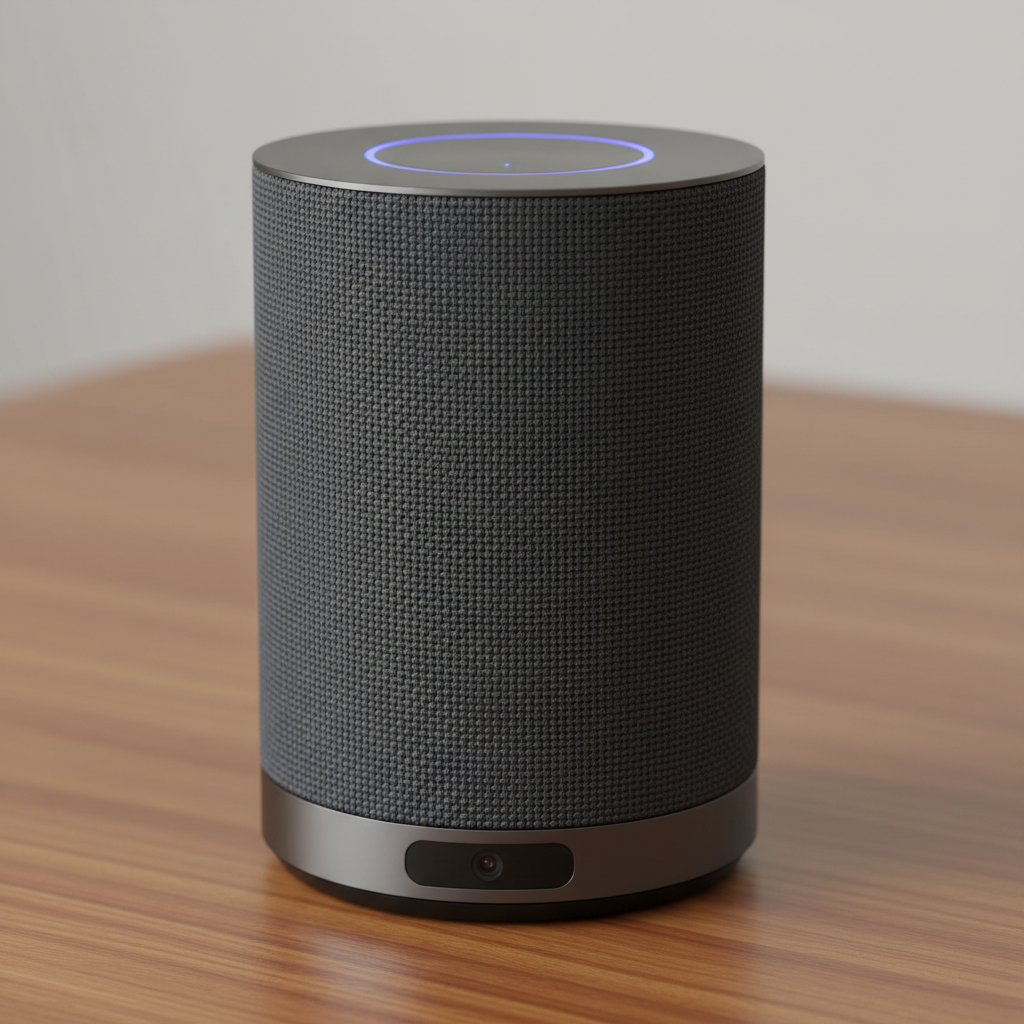
OpenAI’s smart speaker is a mobile, screen-free gadget designed to act more like a personal AI buddy than a conventional voice assistant. Bloomberg’s July 14, 2026 report notes that the unit packs tiny motors for self-propulsion, a rechargeable battery to hop between rooms, plus a camera and sensor array that help it “see” its surroundings.
This matters because, since Amazon launched the first Echo in 2014, most voice assistants have been stuck in place, both literally and figuratively. A speaker that can trail you from the kitchen to the laundry room and retain context across spaces flips that script. If OpenAI pulls it off, Amazon and Google will feel the pressure to accelerate their own “ambient computing” visions, which they’ve been touting for years without delivering a truly mobile device.
How does OpenAI’s screenless speaker actually work?
The gadget blends ChatGPT’s language smarts with physical sensors and a mobility system, opting out of a touchscreen entirely. TechCrunch’s July 14, 2026 coverage describes it as aiming to be less a button-pressing box and more a presence in the room, using its camera and microphones to develop a continuous, lived-in understanding of the household.
There’s no display. Every interaction is voice-based, sound-based, or even movement-based. OpenAI is betting that a natural conversation, complemented by subtle physical cues (like turning a little toward the speaker), feels warmer than a screen full of icons. Whether that gamble pays off will hinge on how fluid the voice experience feels in real life, and so far only OpenAI’s internal testing team has handled a production unit.
OpenAI vs. Alexa+ vs. Gemini for Home: How do they stack up?
OpenAI’s speaker won’t hit shelves until 2027, but it will land in a market already dominated by two well-funded incumbents. Amazon relaunched Alexa+ nationwide in the US in 2026 for $19.99 a month, free for Prime members, according to Amazon’s own announcement on aboutamazon.com. Google rolled out its Gemini-powered Google Home Speaker on June 25, 2026 for $99.99, bundling six months of Google Home Premium (a $60 value), per Google’s official product blog.
| Device | Hardware Cost | Subscription | Standout Feature |
|---|---|---|---|
| OpenAI Speaker (expected 2027) | Not yet announced | Not yet announced | Physical mobility, camera-based context awareness |
| Amazon Echo with Alexa+ | Varies by Echo model | $19.99/mo, free with Prime | 140,000+ compatible smart home devices |
| Google Home Speaker with Gemini | $99.99 | $10/mo after 6-month trial | Natural, multi-step conversational control |
On sheer ecosystem size, Amazon still leans far ahead. Alexa talks to more than 140 000 smart-home products, versus roughly 50 000 for Google Home, according to a 2026 comparison from The Ambient. Amazon also commands about 65 % of the U.S. smart-speaker market, compared with Google’s 25 %, per the same report. That existing base is exactly the hill OpenAI will have to climb from day one.
Is OpenAI’s device truly an “AI companion,” or just a slick speaker?
OpenAI frames the gadget as a companion that learns you over time, not merely a quicker way to set a timer. Bloomberg’s reporting calls it a system that should become increasingly personalized and proactive, surfacing info before you even ask and acting like a household expert on its own.
That’s a fundamentally different pitch from Alexa+ or Gemini for Home, which remain mostly reactive: you ask, they answer or act. A genuinely proactive assistant that notices you’re low on coffee filters or that a delivery is delayed without you asking poses a tougher engineering challenge than voice recognition, and it also runs the risk of feeling invasive if its judgment calls miss the mark. Whether folks want a device that volunteers info unprompted remains an open question the industry hasn’t fully answered.
What would OpenAI’s speaker mean for smart-home integration?
If OpenAI wants the speaker to flip lights, lock doors, tweak thermostats, and peek at cameras, it’ll need the same kind of partnership network Amazon and Google spent a decade building. Matter, the cross-platform smart-home standard backed by Amazon, Google, Apple, and hundreds of makers, is the most straightforward route to that kind of compatibility without OpenAI having to strike one-off deals. Readers looking for a head start on Matter can check out our guide to setting up Matter-compatible smart home devices, since anything OpenAI ships will likely speak that protocol from day one.
OpenAI also lacks its own hub hardware, thermostat line, camera range, or retail footprint comparable to Amazon’s or Google’s. It will either have to lean heavily on third-party Matter and Thread devices or partner with an existing smart-home platform. For a broader look at how AI agents are already being layered onto existing ecosystems, see our rundown of how Alexa+ and Gemini are already redefining smart-home automation.
What are the privacy trade-offs of a camera-equipped home speaker?
A speaker that sports a camera, an always-listening microphone, and a memory of household routines raises a different set of privacy concerns than a static smart speaker. It sees more, remembers more, and (by OpenAI’s own design goals) is built to piece together a longitudinal profile of its user. That’s a real trade-off, not a theoretical one, and it applies just as much to Alexa+ and Gemini for Home, both of which already process voice and increasingly camera or video data to fuel their AI features.
OpenAI hasn’t released a device-specific privacy policy yet, since the product hasn’t launched. That means claims about data retention, on-device processing, or third-party sharing can’t be verified at this point. Anyone evaluating an AI-forward home device (OpenAI’s or otherwise) should wait for a published privacy policy and data-flow diagram before assuming a mobile, camera-enabled speaker will stay entirely local.
Should you wait for OpenAI’s speaker or buy an Alexa+ or Gemini device now?
For most households, betting on a 2027 product with no firm price, release date, or retail plan isn’t a practical smart-home strategy today. Alexa+ is effectively free for the roughly 200 million Amazon Prime members in the U.S., and the Google Home Speaker is a one-time $99.99 purchase bundled with a generous trial period. Both are shipping now and already work with a large installed base of existing devices. Our comparison of the best smart home hubs of 2026 dives deeper.
If you’re already deep in the Amazon ecosystem, with a Ring doorbell, Echo devices, and Fire TV, Alexa+ is the low-friction upgrade, since it rides on hardware you probably already own. If you lean on Google Workspace, Android, or Nest cameras, the Gemini-powered speaker makes more sense. OpenAI’s device is worth watching, but not worth pausing a full product cycle for, unless your current setup is truly broken.
Frequently Asked Questions
When will OpenAI’s smart speaker be released?
OpenAI’s device is expected to be unveiled later in 2026 with a consumer release targeted for 2027, according to Bloomberg’s July 2026 reporting. No firm launch date or price has been announced.
How much does Alexa+ cost?
Alexa+ costs $19.99 a month as a standalone subscription in the US, but it is included free for Amazon Prime members, per Amazon’s official 2026 announcement. Prime itself costs $14.99 a month or $139 a year.
What does the Google Home Speaker with Gemini cost?
The Google Home Speaker launched on June 25, 2026 at $99.99, bundled with six months of Google Home Premium, a $60 value. After the trial, Google Home Premium costs $10 a month for full Gemini Live features.
Will OpenAI’s speaker work with my existing smart home devices?
That isn’t confirmed yet. OpenAI has not announced Matter, Thread, or specific device partnerships for the product, so compatibility with existing smart home ecosystems remains an open question until closer to launch.
Is a camera-equipped AI speaker safe to put in a bedroom or living room?
That depends on the manufacturer’s published privacy policy and data-handling practices, which OpenAI has not yet released for this device. For any camera-equipped speaker already on the market, check whether processing happens on-device or in the cloud before installing it in a private space.
Sources
- Bloomberg, “OpenAI’s First Device Will Be Moveable, Screenless Speaker Built as AI Companion,” July 14, 2026, bloomberg.com
- TechCrunch, “OpenAI’s first hardware device is reportedly a screenless speaker that can move,” July 14, 2026, techcrunch.com
- About Amazon, “Alexa+ now available to everyone in the US, and free for Prime members,” 2026, aboutamazon.com
- Google, “Meet the new Google Home Speaker, built for Gemini,” 2026, blog.google
- 9to5Google, “Google Home Speaker available June 25 for $99, pre-orders today,” June 17, 2026, 9to5google.com
- The Ambient, “Alexa+ vs Gemini: which AI smart home assistant wins in 2026?,” 2026, the-ambient.com